The full picture of your engine — in one report.
INSCYD is the same performance modelling used by pro cycling teams, national federations and elite triathletes worldwide. It turns a single test into a complete physiological profile — VO₂max, VLa max, lactate dynamics, fuel use, training zones and race predictions.
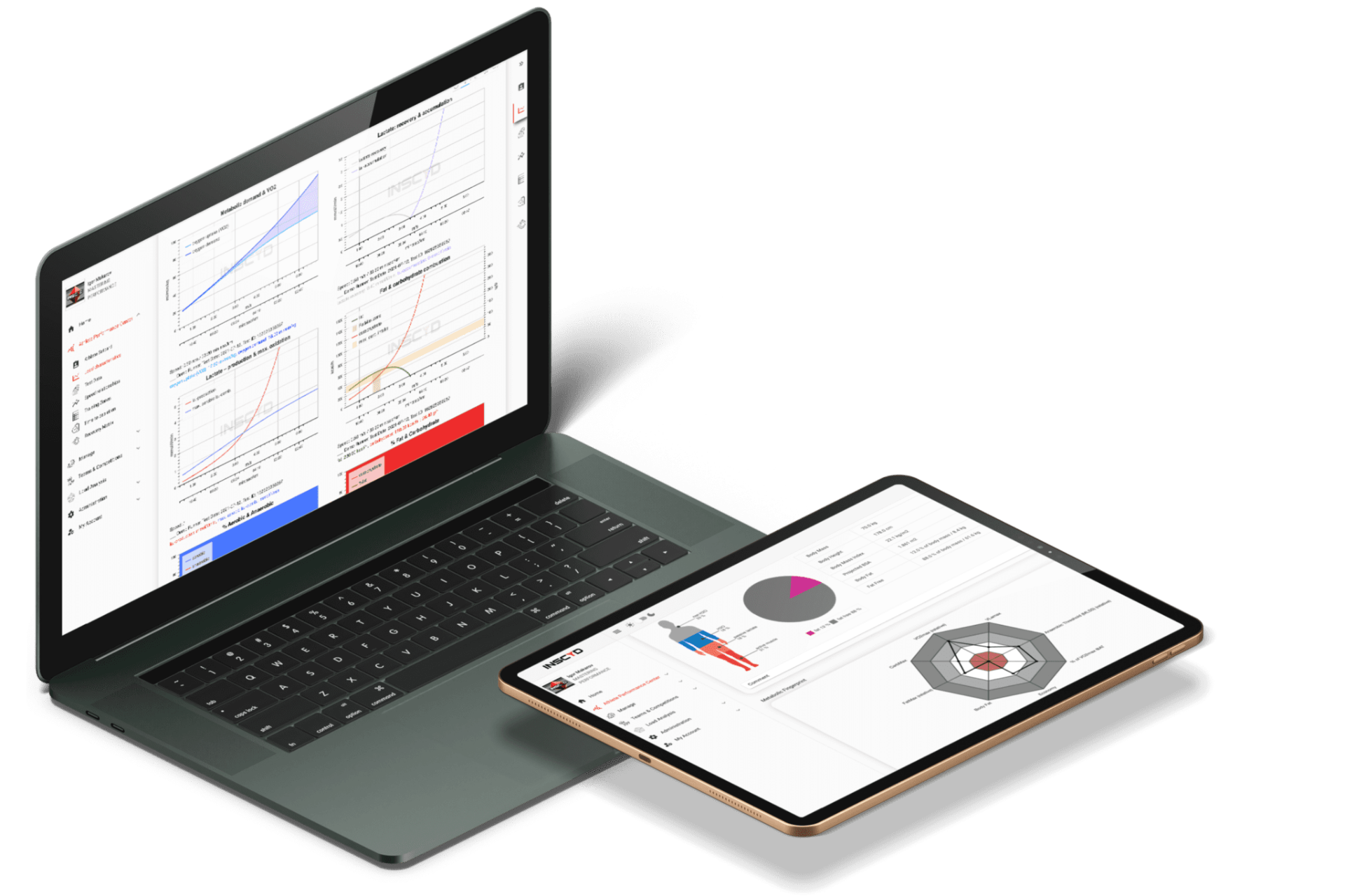
What gets measured
Most endurance tests give you a single number — an FTP, a threshold pace, a heart-rate zone. INSCYD measures the underlying systems that produce those numbers, so you can train the right one.
- VO₂max
- Your aerobic ceiling — the maximum rate at which your body can use oxygen.
- VLa max
- Maximum glycolytic power — how fast you can produce energy anaerobically.
- Anaerobic Threshold
- The intensity you can sustain before lactate accumulation outpaces clearance.
- Lactate Threshold (LT1 / LT2)
- The two physiological transitions that anchor your training zones.
- Fat & CHO Combustion
- Exactly how much fat and carbohydrate you burn at every intensity.
- Economy
- How efficiently you convert energy into pace or power.
Inside Your INSCYD Report
Your report contains far more than just training zones. It provides a detailed picture of how your body produces energy, performs at different intensities, and responds to training.
VO₂max
Your aerobic engine.
A higher VO₂max generally improves your ability to sustain faster paces and higher power outputs.
VLaMax
Your rate of lactate production.
Helps explain whether you are naturally more endurance-oriented or power-oriented and influences race performance across different distances.
Training Zones
Personalised training intensity zones.
Helps remove guesswork and ensures each session targets the right physiological adaptation.
Fuel Utilisation
Your use of carbohydrates and fat during exercise.
Provides insights into endurance performance, pacing, nutrition, and long-distance racing.
Race Predictions
Estimated performance potential across multiple race distances.
Provides realistic performance benchmarks and goal-setting targets.
Threshold Analysis
Identification of key physiological thresholds.
Helps determine sustainable training and racing intensities.
Performance Limiters
Identification of the physiological factors currently limiting performance.
Helps focus training on the areas most likely to produce improvement.
Performance Strengths
Identification of your strongest physiological qualities.
Allows you to better understand your athletic profile and build training around your strengths.
Carbohydrate Demand
Estimated carbohydrate usage at different exercise intensities.
Useful for race planning, fuelling strategies, and endurance events.
FatMax
The exercise intensity where fat utilisation is highest.
Provides insight into aerobic development and endurance efficiency.
Training Recommendations
Practical interpretation of your results.
Helps convert data into meaningful training decisions.
Athlete Report + Follow-Up Consultation
Your personalised Threshold Performance Lab report and follow-up phone call.
Ensures you understand your results and know how to apply them to your training.
From test result to training session.
Find your weakness
We benchmark your numbers against your event and identify the single biggest performance lever.
Set the right zones
Heart-rate and power/pace zones built from your physiology — not a generic percentage of FTP.
Fuel the work
Carb requirements at each intensity, so you can fuel training and racing with confidence.